Landscape Lighting Electrician | Outdoor Lighting Installation & Cost
Landscape Lighting Electrician: What to Know Before You Hire for Outdoor Lighting
Updated October 2026
Hiring a landscape lighting electrician is the difference between a yard that glows at night and one that has flickering lights, buried wires, and tripped breakers by next summer. Outdoor lighting looks simple, but it mixes electricity, weather, and moving soil.
Click the Call Now button below and we’ll connect you with an independent, licensed electrician in your area. Or keep reading to learn how outdoor lighting works, what it costs, and what a good installer does.
Free to call. Electricians are independent, licensed professionals who give their own quotes. Coverage varies by area, so tell us your location.
Safety first. Never dig near buried power lines or outdoor circuits without knowing where they are. Call 811 before you dig. If an outdoor fixture, cord, or outlet is damaged, wet, or sparking, keep people away and turn off the circuit at the panel if you can reach it safely. If there is smoke or fire, call 911.
Why Outdoor Lighting Is Worth Doing Right
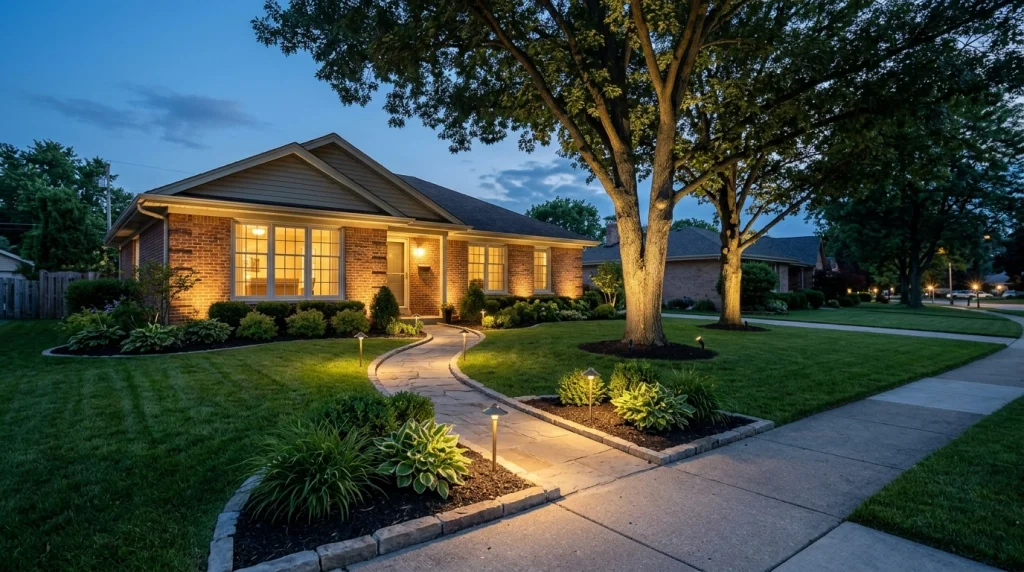
Good landscape lighting does more than look nice. It lights steps and paths so people don’t trip, it makes a home look lived in, and it helps visitors find the front door at night.
But many homeowners who try it themselves, or hire the wrong installer, run into the same problems:
- “My lights are dim or uneven.” The cable run is too long or the transformer is too small.
- “Half the lights went out.” A cut wire, a bad connection, or water in a fixture.
- “The breaker keeps tripping.” Outdoor circuits need proper GFCI protection and weather-rated parts.
- “I don’t know who to trust.” It’s hard to tell a skilled installer from a salesperson.
- “What will it cost?” Prices vary widely, and many quotes leave things out.
This guide answers each one, so you can plan with confidence.
What Does a Landscape Lighting Electrician Do?
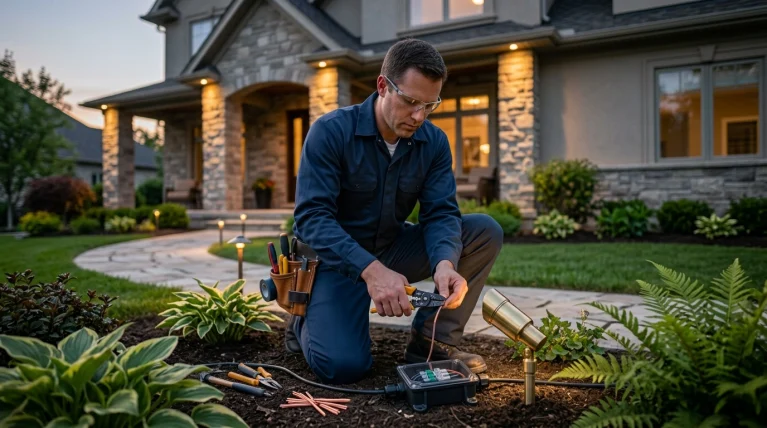
A landscape lighting electrician designs and installs the outdoor lighting system, and handles the electrical work that makes it safe. That usually includes:
- Planning where lights should go for safety and appearance
- Choosing fixtures that suit your yard, trees, paths, and house
- Sizing and mounting a transformer
- Running low-voltage cable and making weather-tight connections
- Adding or checking a GFCI-protected outdoor outlet or circuit
- Setting up timers, photocells, or smart controls
- Testing the system and showing you how to use it
In many homes, the electrician also adds the power source, such as a new outdoor outlet, which is line-voltage work that needs a licensed professional.
Low-Voltage vs. Line-Voltage Landscape Lighting
Most residential landscape lighting is low-voltage, but not everything outdoors is. Knowing the difference helps you ask the right questions.
Low-Voltage Lighting
A transformer plugs into a GFCI outlet and steps household power down, typically to 12 volts. Thin cable runs from the transformer to fixtures. It’s safer, easier to adjust, and the most common choice for paths, gardens, and accent lighting.
Line-Voltage Lighting
Full household voltage runs to the fixture. This is used for floodlights, post lights, some wall lights, and anything that needs high output. It needs proper wiring, weather-rated boxes, and GFCI protection, and it must be done by a licensed electrician.
| Low-voltage | Line-voltage | |
|---|---|---|
| Power | Around 12V from a transformer | Full household power |
| Typical uses | Paths, gardens, accents, uplights | Floodlights, post lights, security lights |
| Install difficulty | Easier, but design matters | Needs licensed electrical work |
| Where the electrician is needed | Power source, transformer, design, safe connections | Everything, including wiring and permits |
Types of Landscape Lighting
- Path lights: light walkways and driveways for safe footing
- Uplights: aimed at trees, columns, or walls for dramatic effect
- Spotlights: highlight features like statues or entryways
- Wash lights: soft light across a wall or fence
- Step and deck lights: mounted into stairs and railings for safety
- Downlights: mounted in trees or eaves for a moonlight effect
- Pond and water lights: sealed fixtures made for wet locations
A good installer will usually mix a few types rather than putting one fixture everywhere.
Need Outdoor Lighting Installed? Click the Call Button
If you’re ready to light up your yard, or your current lights are failing, click the call button below. Tell us where you live and what you want. We’ll connect you with an independent, licensed electrician in your area who can quote the job.
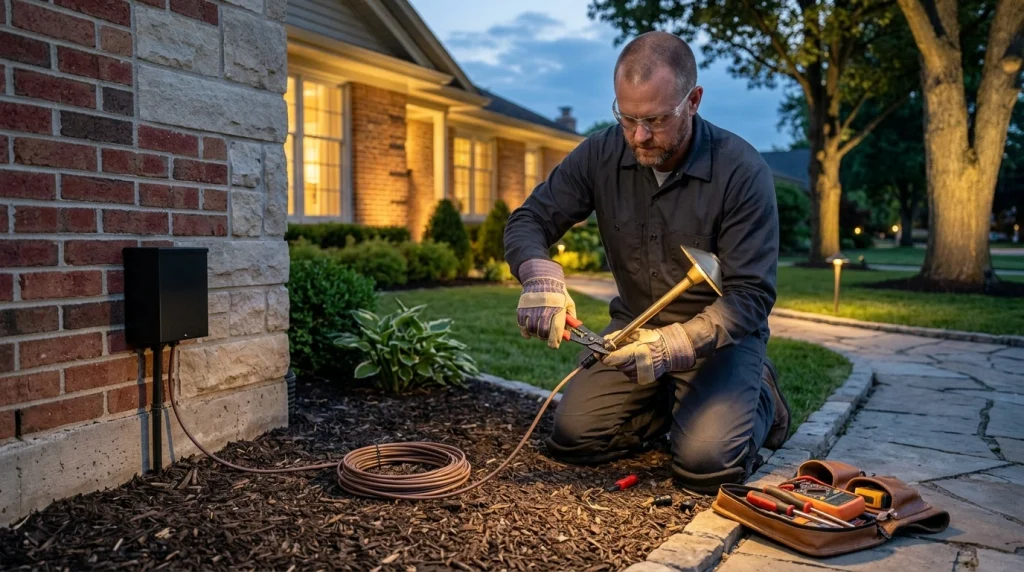
How a Professional Installation Works
Knowing the steps makes it easier to compare quotes. A typical job looks like this:
- Walkthrough. The electrician looks at your yard, house, power sources, and goals, often at dusk.
- Design. They plan fixture types, positions, and the cable route.
- Power check. They confirm you have a GFCI-protected outdoor outlet or add one.
- Install. They mount the transformer, bury or protect the cable, and connect the fixtures with weatherproof connectors.
- Aim and adjust. After dark, they adjust angles and brightness.
- Controls. They set timers, photocells, or smart controls.
- Walkthrough and warranty info. They show you how it works and explain any warranty on parts and labor.
How Much Does Landscape Lighting Installation Cost?
Prices vary by yard size, fixture quality, number of lights, and the electrical work needed. As a rough U.S. guide, which is a planning estimate and not a quote:
| Item | Typical cost |
|---|---|
| Design and site visit | Often free or applied to the job |
| Per fixture, installed (basic) | About $150 – $350 |
| Per fixture, installed (premium) | About $300 – $600+ |
| Small system (a few lights) | Often about $1,000 – $2,500 |
| Whole-yard system | Often about $3,000 – $8,000 or more |
| New GFCI outdoor outlet or circuit | Quote required (depends on distance and access) |
| Smart controls or timers | Add-on cost, varies |
What changes the price:
- Number and type of fixtures (brass and copper cost more than plastic)
- How far the cable has to run
- Whether you need a new power source or panel work
- Soil, rocks, trees, and hardscape that make digging harder
- Controls, dimming, and smart features
Always ask for a written quote that lists fixtures, transformer size, cable, labor, and warranty.
Ready for a Written Quote? Tap the Call Button
A clear quote takes the guesswork out of the project. Tap the call button below, describe your yard, and ask the electrician for a written estimate. There’s no pressure, and you decide whether to go ahead.
Why Hire a Landscape Lighting Electrician Instead of DIY?
Plug-in solar and kit lights are fine for a few spots. For a real system, a professional helps in ways that aren’t obvious until something goes wrong:
- Safe power. Outdoor outlets need GFCI protection and weather-rated covers.
- Correct sizing. Too many lights on one transformer leads to dim fixtures and early failures.
- Weather-tight connections. Water in a connection is the number one cause of failed outdoor lighting.
- Cable protection. Cable buried at the right depth and routed away from digging tools lasts longer.
- Better design. Light placed well looks natural, not glaring.
- Fewer callbacks. A properly tested system avoids repeat visits.
In humid, stormy areas like North Alabama, moisture and heat are tough on outdoor fixtures, so good materials and connections matter even more.
How to Know You Can Trust the Electrician
We are a referral service. We connect homeowners with independent electricians, and we don’t do the electrical work ourselves. Here is how to protect yourself, whoever you hire:
- Ask for the license number. Verify it with the Alabama Electrical Contractors Board, and ask what licensing applies to low-voltage lighting in your area.
- Ask for proof of insurance. Liability coverage protects your property.
- Get the price in writing. It should list fixtures, transformer, cable, labor, and permits if needed.
- Ask about warranty. Know what covers the fixtures and what covers the labor.
- Ask to see examples. Ask about the kinds of systems they’ve done, and for references if they have them.
If someone refuses to show a license or pushes you to pay in full before starting, walk away.
Common Landscape Lighting Problems an Electrician Can Fix
- Lights that flicker, dim, or won’t turn on
- One section of lights goes out
- A transformer that buzzes, overheats, or trips the breaker
- Corroded connectors or water inside fixtures
- Cut or damaged cable from digging or lawn equipment
- Timers or photocells that stopped working
- An outdoor outlet that won’t reset
Many of these come down to a bad connection or a power-supply issue. A quick service visit often solves them. For outdoor power problems, see our guide to an electrical outlet not working and our page on GFCI outlet installation in Huntsville.
Tips for Planning Your Outdoor Lighting
- Walk your yard at night and note where it’s too dark
- Light entries, steps, and changes in grade first for safety
- Use warm light for a welcoming look and avoid glare
- Aim fixtures so they don’t shine into windows or a neighbor’s yard
- Plan for growth: trees and plants will change the layout
- Choose a transformer with room to add lights later
For a bigger project, our guide to outdoor landscape lighting installation goes into design and fixtures. If you’re comparing providers, our page on finding a local electrician in Huntsville can help, and our home electrician service page explains how referrals work.
Keeping Your Outdoor Lighting Working Year-Round
A well-built system needs very little care, but a quick check twice a year prevents most failures.
- Spring: trim plants that have grown over fixtures, clear mulch away from lights, and check for fixtures that have shifted or tilted.
- Summer: look for lights buried by lawn growth, and make sure sprinklers aren’t spraying directly into fixtures.
- Fall: clear leaves from path lights and check the timer or photocell for the shorter days.
- After storms: test the outdoor GFCI outlet and look for fallen branches that may have pulled on cables.
If a section of lights stays dark after you clear debris and reset the GFCI, don’t keep digging around the yard. Call a professional, because a cut cable or a failed connection is usually the cause.
How It Works
- Click the call button. Tell us your location and what you want to light.
- Get matched. We connect you with an independent, licensed electrician in your area, where coverage is available.
- Get a written quote. The electrician reviews the job and quotes the price directly.
- Decide. You choose whether to hire them. No obligation.
Frequently Asked Questions
What does a landscape lighting electrician do?
A landscape lighting electrician designs and installs outdoor lighting, sizes the transformer, runs and protects the cable, adds safe GFCI-protected power, and tests the system. They also fix problems like dim, flickering, or dead fixtures.
How much does landscape lighting installation cost?
A small system often costs about $1,000 to $2,500, and a whole-yard system often costs about $3,000 to $8,000 or more, depending on fixtures, cable runs, and electrical work. These are estimates, so ask for a written quote.
Is low-voltage landscape lighting safe?
Low-voltage systems are generally safer than line-voltage, but they still depend on a safe power source. The outlet feeding the transformer should be GFCI-protected and weather-rated, and connections must be watertight.
Why do my landscape lights keep going out?
Common causes are water in connectors or fixtures, a cut or damaged cable, an overloaded transformer, or a failed timer or photocell. An electrician can trace the fault and repair it.
Are the electricians licensed and insured?
We refer you to independent electricians who are licensed to work in their area. Ask for their license number and proof of insurance, and verify the license with the Alabama Electrical Contractors Board.
Hire a Landscape Lighting Electrician You Can Trust
Outdoor lighting should make your home safer and more beautiful, not become a maintenance headache. A skilled landscape lighting electrician plans the layout, powers it safely, and builds it to survive rain, heat, and soil movement.
Don’t settle for dim lights, buried surprises, or a system that fails in a year. Click the Call Now button below to get matched with a licensed electrician today.