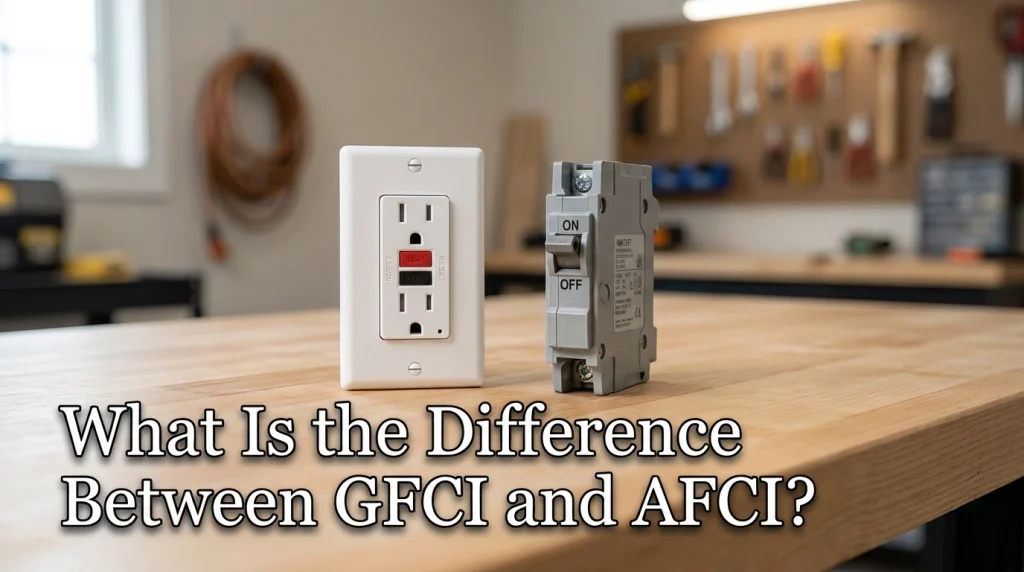
What Is the Difference Between GFCI and AFCI?
Updated October 2026
A GFCI protects people from electric shock by cutting power when current leaks to ground, and an AFCI protects against fires by cutting power when it detects dangerous arcing in the wiring. They do different jobs, and many homes need both.
Click the Call Now button below and we’ll connect you with an independent, licensed electrician who can check or add protection.
Free to call. Electricians are independent, licensed professionals who give their own quotes. Coverage varies by area, so tell us your location.
GFCI vs. AFCI at a Glance
| GFCI | AFCI | |
|---|---|---|
| Stands for | Ground-fault circuit interrupter | Arc-fault circuit interrupter |
| Protects against | Electric shock | Electrical fires from arcing |
| Detects | Current leaking to ground, often through water or a person | Dangerous arcs from damaged or loose wiring |
| Where it’s common | Kitchens, bathrooms, garages, basements, outdoors | Bedrooms and living areas, depending on the code |
| Comes as | An outlet or a breaker | Usually a breaker |
| Tripping can mean | Moisture or a leaking device | Damaged cords or loose connections |
What a GFCI Does?
A GFCI compares the current going out with the current coming back. If a small amount goes missing, it assumes a leak and shuts power off in a fraction of a second. That’s why it matters most near water. See our guide to GFCI outlet installation in Huntsville.
What an AFCI Does?
An AFCI listens for the pattern of a dangerous arc, such as damaged insulation or a loose connection, and shuts the circuit down. Arcs can heat up and ignite materials, often hidden inside walls.
Do You Need Both?
Many newer homes have both, with rules that depend on the code edition and when the home was built. A dual-function breaker combines the two. Older homes often have neither in places where they’re now expected. An electrician can tell you what applies to your home.
Common Problems
- GFCI won’t reset: see why a GFCI won’t reset
- AFCI trips repeatedly: often a damaged cord, loose connection, or a device that confuses the breaker
- Neither installed: consider an electrical safety inspection
What It Costs?
- GFCI outlet, installed: about $100 to $300
- GFCI breaker, installed: about $150 to $400
- AFCI or dual-function breaker, installed: about $150 to $400
These are rough U.S. estimates, not quotes. Ask for a written price.
How to Choose the Electrician?
We are a referral service. We connect homeowners with independent electricians, and we don’t do the electrical work ourselves. Whoever you hire:
- Ask for the license number. Verify it with the Alabama Electrical Contractors Board.
- Ask for proof of insurance.
- Get the price in writing, listing the work, the parts, and any permit.
- Ask what is covered by the warranty.
Frequently Asked Questions
Is a GFCI the same as an AFCI?
No. A GFCI protects against shock from current leaking to ground, and an AFCI protects against fires from dangerous arcing.
Where are GFCIs required?
Codes generally call for them in bathrooms, kitchens, garages, unfinished basements, outdoor areas, and near sinks. Rules vary by code edition and home age.
Can I use a GFCI where an AFCI is needed?
They protect against different hazards, so one doesn’t replace the other. A dual-function breaker provides both.
How often should I test them?
About once a month. Press Test and Reset on GFCI outlets, and use the test button on AFCI breakers.
Not Sure Which Protection Your Home Has?
You don’t have to guess. Click the Call Now button below and we’ll connect you with an independent, licensed electrician who can check your home.